
The Innovative Secondary Education for Skills Enhancement (ISESE) Competition blog series features the winners, runners-up and five additional models that have been selected due to their innovation, impact, sustainability and potential for replication in Africa and Asia. This is Part 2 of our 10-part series.
“Educational attainment is a measure of human capital - the skills and competencies of the population - and thus an indicator of a country's potential for economic growth.” – Friedrich Huebler
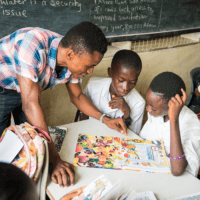
The kind of education a child receives dictates his or her future. In Senegal, a country where less than five percent of its population 25 and older has a secondary education, FHI 360 works with the Ministry of Education, civil society, and the business sector to improve the middle-school curriculum with funds from USAID. This reform is intended to create a curriculum that teaches relevant 21st century skills.
In recognition of FHI 360’s program, R4D awarded them a $1,000 cash prize as the winner of the Africa region in our ISESE Competition. Their program brings state-of-the-art teaching methods, including information and communications technology (ICT), student-based governance, and private sector involvement into middle schools in Senegal to prepare students in meeting the socio-economic development needs of their country.
The sustainability of this model enhances the Ministry of Education’s capacity to implement best practices developed by the project at 230 project-supported schools and to replicate them in over 1,000 middle schools nationwide.
To learn more about FHI 360 and their programs, please visit www.fhi360.org and the project’s public-private partnership campaign website, www.touspresent.com.
Stay tuned for the rest of our series and check in next week to learn about the runner-upeducation model for Vietnam.
- Part 1: Yuwa – Kicking It New School
- Part 2: Improving the quality and relevance of middle school in Senegal
- Part 3: IT training for youth with disabilities
- Part 4: Multi-Skill Vocational Training and Entrepreneurship Development as Part of Secondary Education
- Part 5: Emusoi Centre
- Part 6: Arts-based Learning for English Language Skills: Local Culture and Place-based Education
- Part 7: Optimizing Secondary Schools for Skills and Livelihoods through PPPs and CSR
- Part 8: Joyful Learning in Non-Government Secondary Schools in Bangladesh: Public Private Partnership
- Part 9: Rural Youth Empowerment Programme
- Part 10: UCEP: A Beacon of Hope
Monica Wong is a summer intern at Results for Development Institute. When she’s not engulfed in her MBA studies at Georgetown University, she enjoys listening to live music on lazy Sundays while doing crossword puzzles.
Photos: Computer labs of in "EDB schools." (USAID/FHI 360 ICT Team in Senegal)